Clutter, Stress and the Quiet Architecture of Overwhelm
So… let’s talk about clutter
As part of my work with clients, we often end up talking about the domestic or working environment.
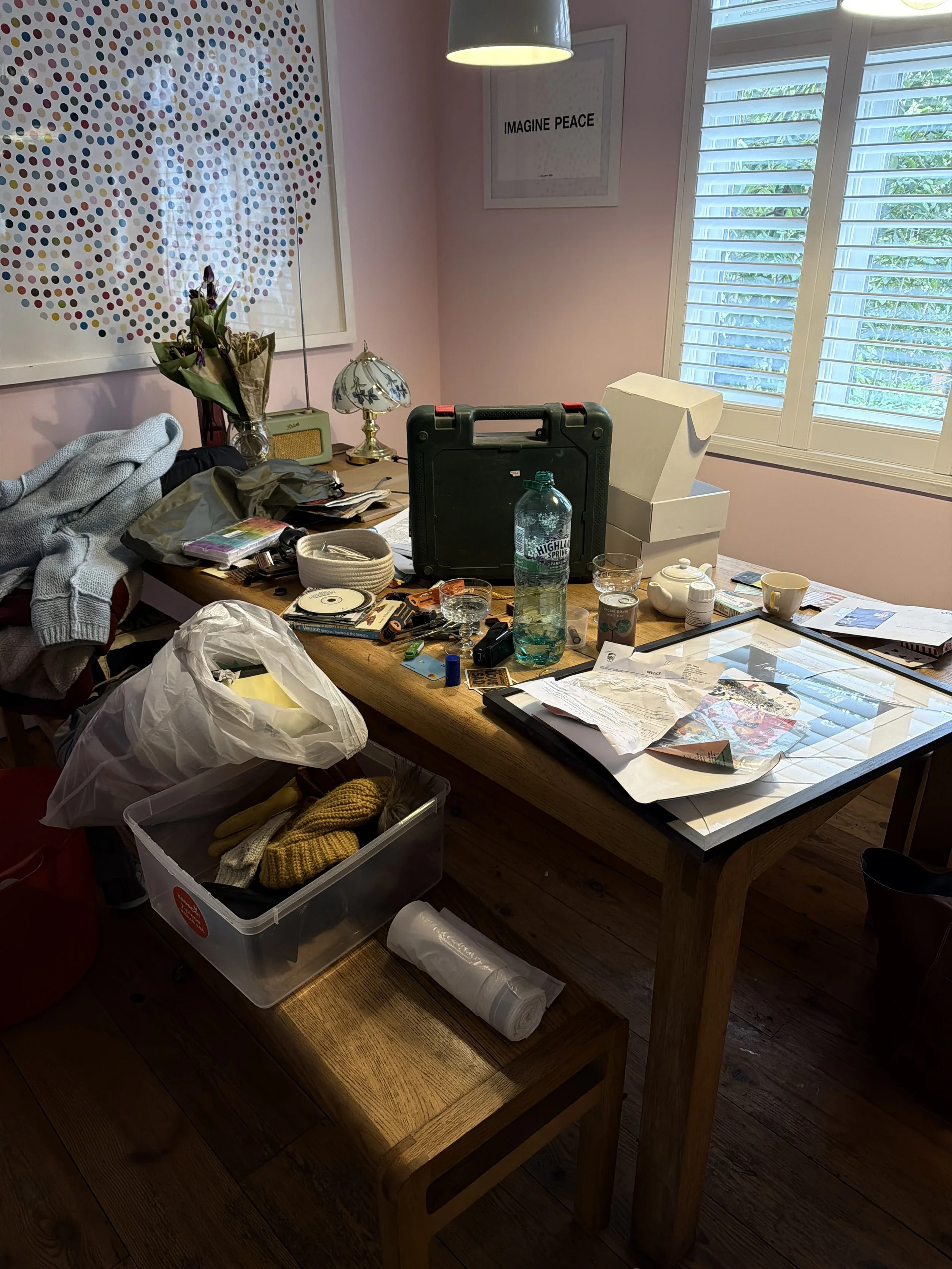
Not just habits. Not just mindset. Not just the fantasy of the perfectly structured week. But the actual physical setting in which a life is being lived: the dining table, the kitchen counter, the bedroom corner, the ‘floordrobe’.
Because environment matters.
We talk a lot about discipline, motivation, routine, productivity. All of which is important, useful. But if you are trying to think clearly, do meaningful work, hold a family together, pursue a dream and possibly remember where you put your glasses (they’re on your head, stupid), all while surrounded by piles of paper, half-finished admin, random cables and three mugs in various stages of abandonment, then your environment is not incidental. It is active and it is shaping the mood.
There is a recognised link between clutter, stress and mental overload. A cluttered environment can make it harder to focus, harder to settle and harder to rest. Which is deeply inconvenient, given that many of us are already one rogue laundry basket away from an existential crisis.
Clutter and mental health: the low hum of unfinished business
When is a cluttered room just a cluttered room? Rarely!
More often, it is a visible record of deferred decisions, of unfinished business. Every object seems to emit a psychic demand: sort me, wash me, file me, mend me, return me, move me, deal with me, think about me. Even when you are technically “relaxing,” your environment is still asking your brain to remain on duty. Like a toddler on overload, or a needy lover.
That is one reason clutter affects mental health.
It creates visual noise, yes, but also emotional noise. It can generate guilt, agitation, avoidance, procrastination and the domestic despair that comes from feeling surrounded by evidence of your own incompletion. A room can become an atmosphere. An atmosphere can become a mood. A mood can become a story you start telling yourself about your life.
I am behind. I can’t keep up. I never get on top of things. I don’t know where to start.
None of which may be objectively true. But clutter is excellent at making this feel true.
Why women so often feel this is their responsibility
I think this is especially true for women.
So many women are not creating or working from protected, purpose-built space. They are working in the gaps of family life. At the table during school hours. On the sofa with a laptop balanced among the remnants of the day. In the hour before everyone else wakes up. In rooms that are doing six jobs at once.
Home is not just home. It’s an office, kitchen, inbox, emotional processing centre, logistics hub and stage set for everyone else’s needs.
So when we talk about clutter, we are not just talking about “stuff.” We are often talking about what happens when a woman has no clear boundary around her own attention. No dedicated room. No real threshold between her work and the rest of life. No visual message that says: you deserve space too.
A cluttered environment does not just distract. It diminishes. It can make your own thoughts feel secondary to the endless material evidence of everybody else’s existence.
Why clutter accumulates so easily in family life
For years I lived in a cluttered environment, unable to deal with the overwhelming task of clearing it. I could see it. I could feel the subtle oppression of it. I knew that it was making life harder. And yet I still was unable to act.
Which makes sense, really, because family life creates clutter at an extraordinary rate. Stuff enters the house constantly. It just appears out of nowhere! School letters. Bags. Shoes. Chargers. Art projects. Post. Half-used notebooks. Laundry. Gifts. Things to be returned. Things to be put upstairs. Things we are keeping “just in case.” Things no one wants, but no one sees it as their responsibility to remove. And because each individual object seems small, it is easy to underestimate the cumulative effect. But together they create a psychic traffic jam.
So much clutter is simply delayed decision-making. Not because people are lazy, but because they are tired. Because there are always more urgent things. Because some decisions carry emotional weight. Because sometimes the act of sorting feels like it requires an entirely different personality from the one currently available.
Clutter is not laziness. It is often grief, guilt, nostalgia and hope piled quietly in the corner.
This, for me, is the important bit.
Clutter is rarely just mess. More often, it is emotional material in physical form. Nostalgia. Guilt. Exhaustion. Wishful thinking. Fear of waste. Fear of finality. Attachment to a former self (the thin one) or to a future self we are not yet ready to give up on.
The jeans we might wear again. The lamp we are definitely going to fix. The books that belong to the version of us who has time to read. The craft supplies purchased for our future life as a serene and capable maker of beautiful seasonal things, the mother who plays with her child rather than plonk her in front of the telly.
Objects are rarely only objects. Sometimes they are aspirations with dust on them.
Which is why decluttering can feel oddly tender, and why “just get rid of it” is not always the profound intervention people think it is. Sometimes you are not clearing a shelf. Sometimes you are deciding whether an old story still gets to live in the room and remain part of your life.
How clutter affects focus and creativity
If your environment is full of visual noise, your attention has more to negotiate.
It becomes harder to begin. Harder to think. Harder to sit down and do the work that actually matters because every surface is reminding you of twelve other things that still need doing. Clutter adds friction. It drains energy before the day has properly started. And this matters particularly if you are trying to do creative work.
Creativity does not always require silence or minimalist perfection, but it does need some space. Some room to land. Some feeling of possibility. Some absence of psychic interference. When your table is buried, your mind can feel buried too.
This is one of the reasons I talk to clients about their environment. Because often what looks like a motivation problem is, at least partly, an environmental one. They are trying to create focus in a space that constantly signals interruption. They are trying to access clarity in the middle of visual backlog. They are trying to produce something meaningful while surrounded by the administrative debris of ordinary life.
Sometimes the answer is not more effort. It is less friction. And one cleared surface changes the entire emotional temperature of a room.
What I am learning from clearing my own space
As part of my decision to coach myself as I would coach my clients, I have taken the leap. I like to think this is me leaning into the powerful Fire Horse energy of the Chinese New Year, while also trying to slither out of the old snakey skin of a former life. Because something in me has changed. I don’t want my environment to rehearse overwhelm. I don’t want to live in rooms that reflect backlog, delay and old identities. I want my surroundings to support the life I say I am building. I want more calm, more beauty, more intention. I want my table to be a table again, not an accidental installation piece called Woman Under Pressure.
Not perfection. Not minimalism. Not a house so pristine it looks like nobody has ever eaten toast in it. Just space. Room to think. Room to breathe. Room to become.
How to start decluttering when you feel overwhelmed
If you feel overwhelmed by clutter, the solution is almost never to attempt a grand domestic resurrection in one afternoon. Start smaller than your ego thinks is impressive.
Clear one surface. Empty one box. Fill one donation bag. Reset one corner of one room. Choose one category and finish it properly. That is enough.
The point is not to become a different person by teatime. The point is to interrupt the spell. To stop rehearsing the story that this is too much, too chaotic, too far gone. It isn’t. It is simply many small decisions waiting to be made one at a time.
Decluttering for mental clarity is rarely glamorous. It is often repetitive, faintly annoying and surprisingly emotional. But it works.
A few familiar examples of clutter doing what it does
The dining table that now functions as office, post room, family archive and accidental museum of things no one has put away.
The bedroom chair carrying clothes in that mysterious category known as “not dirty, not clean, not ready for commitment.”
The basket of random cables that everyone believes are important but no one has touched since 2022.
The spare room that can no longer be spared because it has become a holding zone for old projects, laundry overflow and things awaiting a future version of you.
The bag by the stairs that has become part of the architecture.
These things are ordinary. Common. Almost funny. But they still have an effect. They still shape the way a room feels, and the way you feel in it.
Final thoughts: decluttering as an act of support
Decluttering is not a moral virtue. It does not make you superior, saintly or more evolved than somebody with a chaotic drawer full of batteries and birthday candles.
At its best, it is an act of support. A way of making your environment kinder to your nervous system. Reducing friction. Creating conditions in which focus, rest and creativity have some chance of returning. Because your environment shapes your life more than you think.
Sometimes the most intelligent, compassionate and quietly radical thing you can do is clear the table.
Work with me
If your environment is draining you, distracting you or quietly keeping you stuck, this is something we can work on together. I help clients create practical, meaningful changes to their habits, routines and environments, so life feels calmer, clearer and more intentional.
If you are ready for more focus, more space and a life that feels easier to inhabit, get in touch to find out more about coaching.
If your space is affecting your focus, energy or wellbeing, get in touch to find out how coaching can help.